

News and Insights
Article
|23 October 2026
Published in Gallery Magazine's Family Law Supplement - October 2026
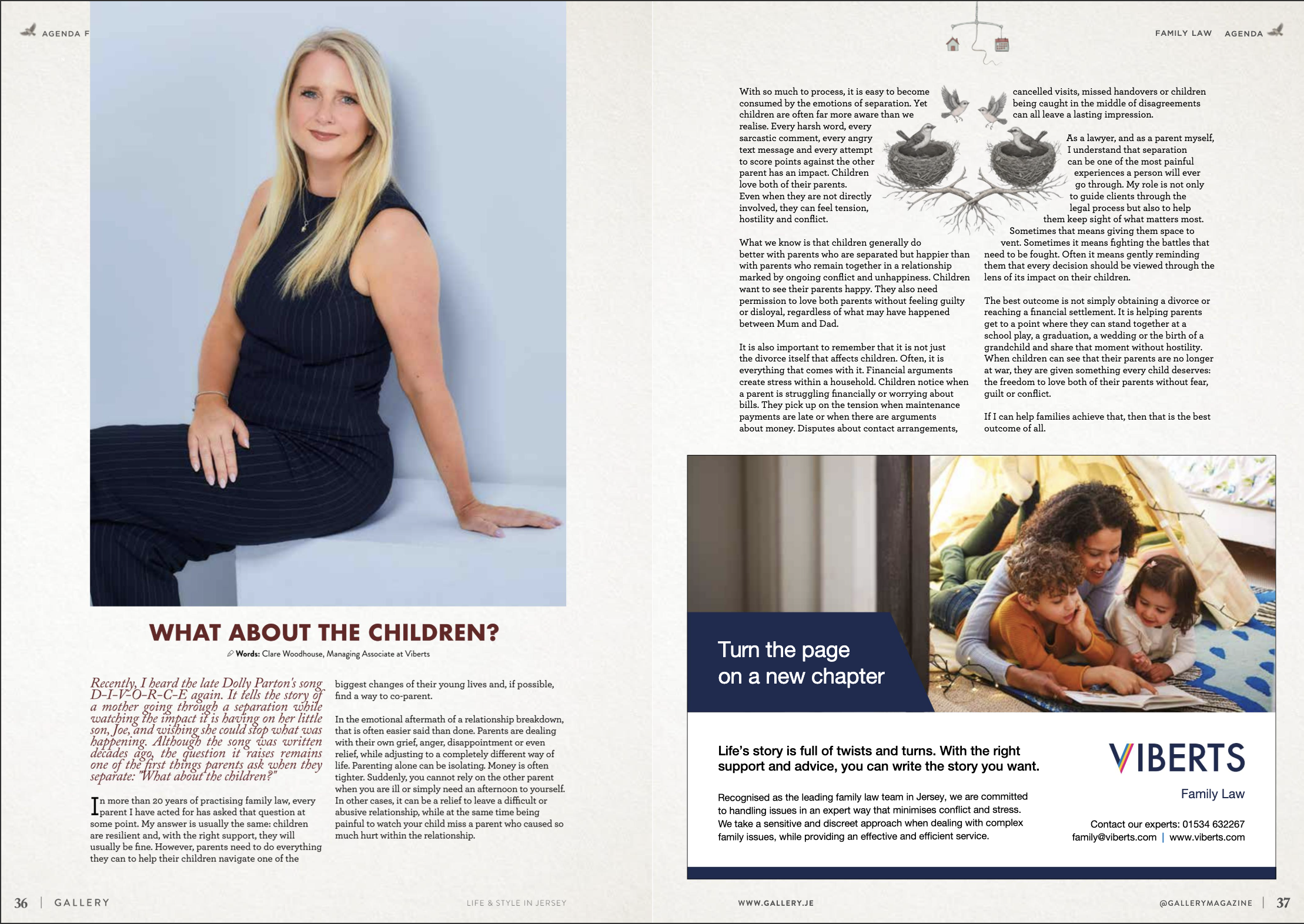
This article examines the legal issues affecting children when their parents’ divorce, focusing particularly on the importance of ensuring that children's voices are heard. Clare Woodhouse argues that divorce and separation can have a lasting emotional impact on children, especially when decisions about where they live and how much contact they have with each parent are made without considering their wishes and feelings.
The central message is that children should not become overlooked in disputes between separating parents. Their welfare wishes and feelings should be given meaningful consideration in decisions that shape their lives.
Recently, I heard the late Dolly Parton's song D-I-V-O-R-C-E again. It tells the story of a mother going through a separation while watching the impact it is having on her little son, Joe, and wishing she could stop what was happening. Although the song was written decades ago, the question it raises remains one of the first things parents ask when they separate:
"What about the children?"
In more than 20 years of practising family law, every parent I have acted for has asked that question at some point. My answer is usually the same: children are resilient and, with the right support, they will usually be fine. However, parents need to do everything they can to help their children navigate one of the biggest changes of their young lives and, if possible, find a way to co-parent.
In the emotional aftermath of a relationship breakdown, that is often easier said than done. Parents are dealing with their own grief, anger, disappointment or even relief, while adjusting to a completely different way of life. Parenting alone can be isolating. Money is often tighter. Suddenly, you cannot rely on the other parent when you are ill or simply need an afternoon to yourself. In other cases, it can be a relief to leave a difficult or abusive relationship, while at the same time being painful to watch your child miss a parent who caused so much hurt within the relationship.
With so much to process, it is easy to become consumed by the emotions of separation. Yet children are often far more aware than we realise. Every harsh word, every sarcastic comment, every angry text message and every attempt to score points against the other parent has an impact. Children love both of their parents. Even when they are not directly involved, they can feel tension, hostility and conflict.
What we know is that children generally do better with parents who are separated but happier than with parents who remain together in a relationship marked by ongoing conflict and unhappiness. Children want to see their parents happy. They also need permission to love both parents without feeling guilty or disloyal, regardless of what may have happened between Mum and Dad.
It is also important to remember that it is not just the divorce itself that affects children. Often, it is everything that comes with it. Financial arguments create stress within a household. Children notice when a parent is struggling financially or worrying about bills. They pick up on the tension when maintenance payments are late or when there are arguments about money. Disputes about contact arrangements, cancelled visits, missed handovers or children being caught in the middle of disagreements can all leave a lasting impression.
As a lawyer, and as a parent myself, I understand that separation can be one of the most painful experiences a person will ever go through. My role is not only to guide clients through the legal process but also to help them keep sight of what matters most. Sometimes that means giving them space to vent. Sometimes it means fighting the battles that need to be fought. Often it means gently reminding them that every decision should be viewed through the lens of its impact on their children.
The best outcome is not simply obtaining a divorce or reaching a financial settlement. It is helping parents get to a point where they can stand together at a school play, a graduation, a wedding or the birth of a grandchild and share that moment without hostility. When children can see that their parents are no longer at war, they are given something every child deserves: the freedom to love both of their parents without fear, guilt or conflict.
If I can help families achieve that, then that is the best outcome of all.